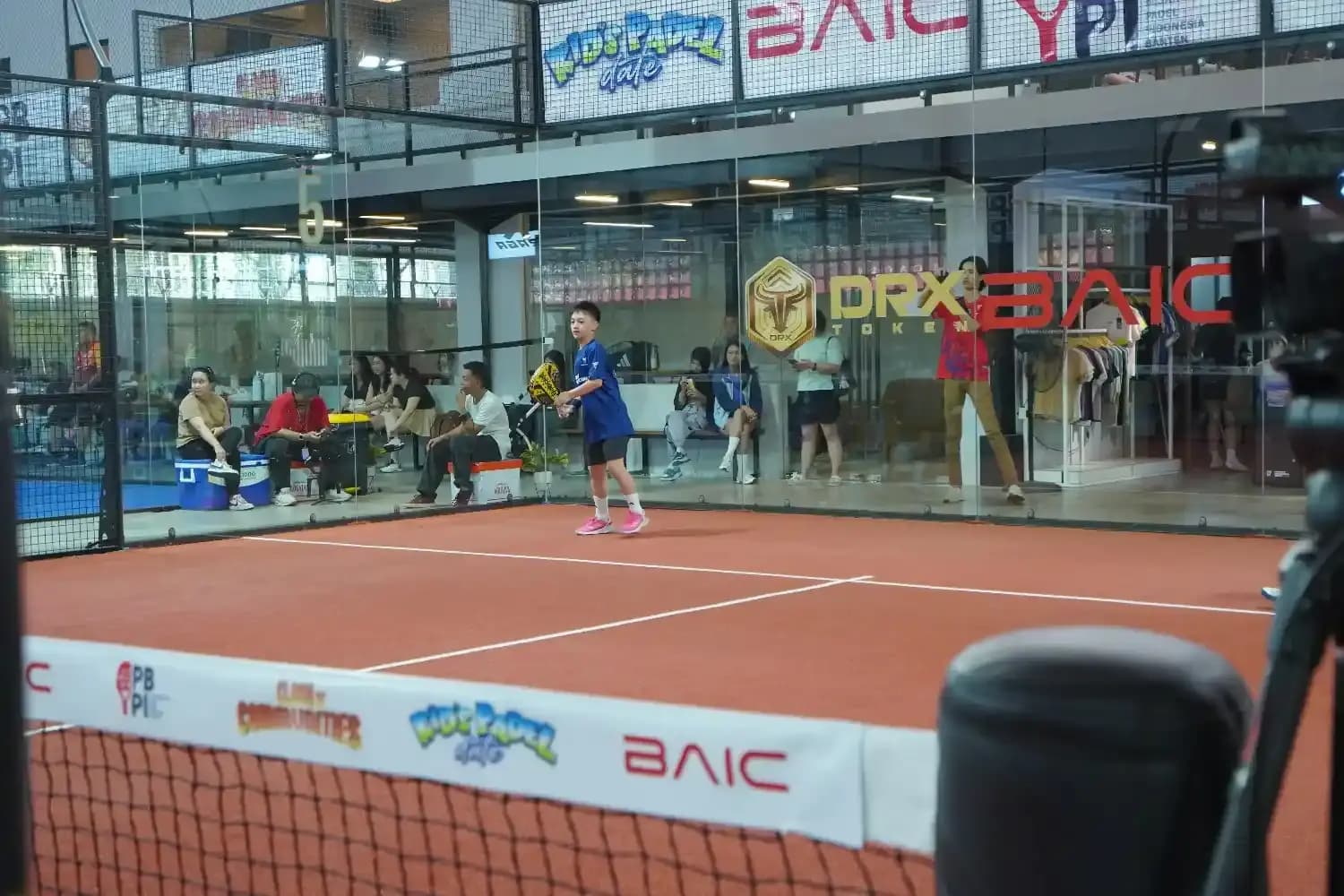
So, you want to start playing padel, but you don't know where to begin. Padel is the easiest racket sport for beginners to learn—in just one hour, you can already play a basic rally, unlike the weeks it takes in tennis. It's perfect for socializing with friends or family on the courts of Jakarta, burning calories while strengthening relationships.
This article is a complete guide to equipment preparation, racket grip, underarm serve, forehand/backhand strokes, mini rules, and tips to avoid common mistakes, so you can quickly become a master in padel. Before diving in, refresh your basic knowledge in the main article: What is Padel?
What is Padel? (An Overview)
Padel is a racket sport in played in doubles format (2 vs. 2) on a 20 by 10-meter enclosed court, where glass walls serve as strategic allies—balls bouncing off the walls stay in play. Underarm serves are safe, solid rackets are easy to control, and rallies averaging 12 shots make the game exciting without causing quick fatigue. Why is it suitable for beginners? The walls forgive balls that bounce out, the team format reduces individual pressure, and 80% of new players in Indonesia continue playing after 5 sessions, according to PPSI 2025 data.
Preparations Before Playing Padel
Don't go straight into the court—preparation makes the difference between enjoyment and frustration.
Basic Padel Equipment
- Padel racket: Beginners should choose a round shape for bettercontrol. A racket weighs 350-370g and costs around IDR 800,000-1.5 million. Recommendations: DRX Wear Control or Head Flash—soft, anti-slip grip.
- Padel ball: Balls are depressurized for low bounce. A tube of 3 balls costs IDR 100,000. Head Pro S or Bullpadel Multi are durable on Jakarta’s grass courts.
- Shoes & clothing: Grass shoes (anti-slip, IDR 500,000+), dry-fit t-shirt, elastic shorts. Don’t wear street shoes to avoid damaging the court.
- Rent equipment at a club (IDR 100,000-200,000 per session) before buying. A full starter kit of IDR 2 million is sufficient for 6 months.
Warm Up Before Playing
Do these for 5-10 minutes:
- Speedwalk around the perimeter of the court.
- 20 arm circles.
- Squats and lunges, 10 times for each leg.
- Shadow swing (swing your racket without hitting a ball).
This prevents wrist sprains and improves agility. According to an FIP study, warm-ups reduce the risk of injury by 40%.
Basic Position and Racket Grip
Basic foundation is essential. With the wrong grip, you can only produce short rallies.
How to Grip A Padel Racket
Continental grip is the most universal grip method in padel. Hold the racket like a “hammer handshake”—palm on the bevel 2 of the racket (right side of the forehand). The thumb supports the backhand and fingers are relaxed. To check, look at bevels 1-8 on the racket, choose the one that makes your hand point to your right shoulder.
Visual tip: imagine slicing a bread. The handle should be held snugly, not tightly.
How to Position Your Body
Start by practicing a ready position: knees bent, weight on the balls of your feet, racket in front of your chest (like a bodyguard), eyes on the ball.
- Front player: net-ready, knees bent.
- Back player: split step (small hops) to anticipate the ball
When moving, do a side shuffle (move from side to side), not run back and forth. This conserves energy in a 10-meter-wide area.
How to Serve in Padel
Padel serves account for 70% of beginner points—master this, and winning is easy.
Padel serves are always underarm. Stand in the back box (feet not touching the line), throw the ball low, and hit it below the waist diagonally to the opponent's box. The ball must bounce on the opponent's floor before being returned.
Feet position while serving:
- Right foot forward (right serve), left foot back.
- Racket relaxed, ball in non-racket hand.
Correct serve direction: target the corner of your opponent’s box (near the wall)—this forces your opponent to stretch.
Common serve mistakes:
- The ball is thrown too high (fault).
- Your foot touches the line (foot fault).
- The ball bounces directly on the wall, not the floor.
Practice daily by doing 50 serves at the wall. Once you reach 80% accuracy, you can start joining a match.
How to Hit A Padel Ball
Padel is not a competition of who can smash the hardest. Focus on 80% control, 20% power.
Forehand and Backhand Strikes
Forehand:
- Rotate your hip.
- Swing your racket from low to high.
- Follow the ball’s movement all through your shoulders.
- Target the center of the court with a light spin.
Backhand (ideal for beginners):
- Turn your shoulder and pull your racket back.
- Strike forward, don’t attempt slices yet.
- Your footwork should start with a cross step with your left foot.
Practice drill with a partner: do 20 forehand strikes, then backhand. Repeat for 3 sets.
Use the Wall
The ball is allowed to bounce off the wall (only once after bouncing off the floor). A good beginner’s strategy is to lob to the opponent's back wall (over 3 meters high).
Watch out for a common mistake: bouncing the ball directly off the opponent's wall, as this counts as a fault. Also, don’t ignore the wall, as you will be wasting your chances and let the ball go out of bounds.
Tip: Imagine the wall as a bonus area that can extend your rally to over 15 hits.
Basic Rules that Beginners Should Know
A short list of rules to avoid chaos and confusion on the court. Read the full guide in Basic Padel Rules.
- The ball must bounce once on the opponent's floor before being returned (post-serve).
- If the ball goes over the wall or hits the mesh, the ball is out. If it bounces inside, it is still at play.
- Short scoring: 15-30-40-game, deuce-ad, best-of-3 sets.
- No-volley zone: no volley within 3 meters of the net.
- In the case of a fault (net touch, double bounce, etc), the opponent gets the point.
Common Padel Beginner Mistakes
Avoid these pitfalls—90% of beginners lose because of:
- Hitting too hard: Opponent wins. Solution: soft hands, safe target.
- Wrong position: Moving too far forward (net trap). Solution: stay in zone (front/back).
- Lack of communication with partner: Calls of “Mine! Yours!” is mandatory. Solution: call the ball loudly.
- Wild serves, weak backhands, and ignoring lobs.
Record video of session 1 and analyze your performance. This can increase your progress by 50% in session 2.
Tips to Master Padel Quickly for Beginners
Level up in 10 sessions with these tips.
- Focus on long rallies: Target 10 shots before a winner—build consistency.
- Play safe first: Lobs are easier to master than smash. Focus on the middle zone over risk corners.
- Partner communication: Call out “Switch!” or “Lobs!” Teamwork accounts for 60% of wins.
- Regular practice: Practice for 45 minutes, twice a week. Do shadow swings and wall drills at home.
- Join a community: Padel Jakarta Facebook group offers free sparring sessions for beginners.
- Get a coach: 3 sessions (Rp300,000 an hour) gives high ROI and helps you reach proficiency in 1 month.
Conclusion
How to play padel for beginners in a nutshell: prepare gear (round racket, turf shoes) and practice the continental grip, underarm diagonal serve, and control-focused forehand and backhand. Leverage the walls, follow the one-bounce rule, and memorize the tennis scoring system. Padel is easy, fun, and social—the compact court makes for instant fun and minimizes injuries, perfect for Jakarta's urban lifestyle.
Start today: book a court for IDR 400,000/hour, bring friends, and feel the rally addiction. Read about the Differences Between Padel and Tennis to understand the broader context. Ready for your first racket swing?