Padel is a racket sport that is rapidly growing in Indonesia. Its popularity is increasing with the emergence of many clubs, communities, and modern facilities such as Padel Hub by DRX.
However, despite all the excitement, many players—especially beginners—still do not fully understand the rules of padel.
Understanding padel rules is not only about avoiding technical errors, but also about building an important foundation for creating a fair, comfortable, and professional game.
This article will discuss the complete rules of padel, including the basics of the game, serving, scoring, and etiquette while playing, so you can play with confidence on the court.
What are Padel Rules and Why They are Important
Rules as the Foundation of a Fair Match
Padel rules are a set of official rules that govern the game, including game format, how to serve, scoring systems, and types of violations. Without a good understanding of the rules, padel games have the potential to:
- Spark arguments between players
- Disrupt the flow of the game
- Diminish the essence of fair play
With a clear set of rules, every player has the same standards when playing.
The Role of Regulation in Modern Padel Communities and Clubs
In modern padel communities, rules are an important element in:
- Maintaining the quality of the game
- Uniting players of various levels
- Shaping a culture of sportsmanship
Doubles Format (2 vs 2) as the Standard
One of the most basic padel rules is the format:
- 2 versus 2 (doubles)
- This format is mandatory in official matches.
- Unlike tennis, padel is not played as singles in the standard competitive format.
Recreational vs Competitive Format
- Recreational: more flexible, focused on fun
- Competitive: follows the official rules of the FIP (International Padel Federation)
A Structured Playing Experience in Padel Hub by DRX
At Padel Hub by DRX, the game format is tailored to the player's level, so that:
- Beginners don't feel pressured
- Intermediate players can improve
- Advanced players remain competitive
Padel Court Size and Rules for Using the Walls
Official Court Size Standards
According to official padel rules
- Length: 20 meters
- Width: 10 meters
- Covered by glass walls and mesh wires
The Function of Glass Walls & Mesh Wires
The walls don’t just serve as boundaries, but also:
- An active part of the game
- Can be utilized for the ball to bounce off of
- Improves rally dynamics
Modern Padel Courts in Padel Hub by DRX
Courts in Padel Hub by DRX is built based on international standards, ensuring:
- Consistent ball bounces
- Guaranteed player safety
- Optimal match experience
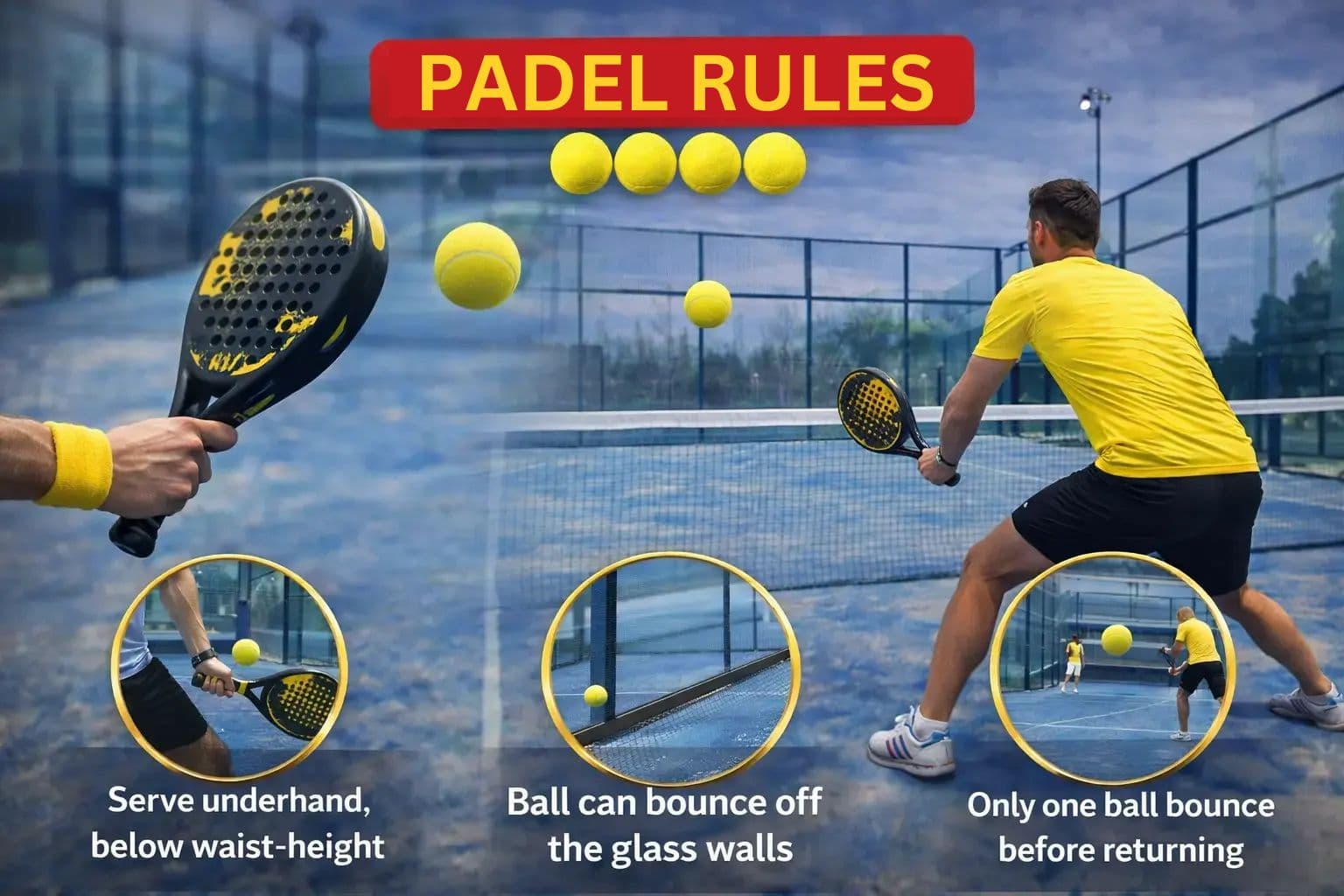
Serve Rules in Padel that You Should Know
Serve Position and Ball Direction
Padel serve rules
- The serve is performed below the waist.
- The ball must bounce on the ground first.
- Serve diagonally to the opponent's service box.
Common Serve Mistakes
Common mistakes:
- The serve is too high.
- The ball does not enter the service box.
- Stepping on the line during the serve.
Calculating Padel Score (Game, Set, Golden Point, Americano & Mexicano)
The General Padel Scoring System
Scoring order: 0 (love), 15, 30, 40, game
System: game → set → match
Typically uses the best of 3 sets format
The Golden Point Rule
- Applies when the score is 40–40 (deuce)
- One deciding point without advantage
- The receiving team chooses the serve side
- The winner of the point wins the game immediately
Golden point is very popular in:
- Padel communities
- Social events
- Beginner practice
Padel Americano Scoring (Community Format)
Americano is a padel game format that does not use a set system but rather accumulates points.
Features of Americano scoring:
- Players switch partners every round
- Each round is played until a certain number of points (usually 16 or 21 points)
- Points are recorded individually
- The winner is determined by the highest total points
Suitable for:
- Community play
- Social events
- Fun but still competitive practice
This format is commonly used in community events held by Padel Hub by DRX because it:
- Is more inclusive
- Actively involves all players
- Has less competitive pressure
Padel Mexicano Scoring (Rank-Based Competitive Format)
Mexicano is similar to Americano but with a higher level of competitiveness.
Features of Mexicano scoring:
- Scoring is still based on point accumulation
- Pairs for the next round are determined by the provisional ranking
- Players with high points will face other strong players
- Rankings are updated every round
Suitable for:
- Competitive community events
- Mini tournaments
- Determining internal ranks in a club
In Padel Hub by DRX, the Mexicano format is used to:
- Measure player consistency
- Form balanced pairings
- Improve the community's playing level
Summary of Different Padel Scoring Systems
| Format | Scoring System | Pairs | Competitiveness |
| Regular Padel | Game & Set | Fixed | Competitive |
| Golden Point | 1 deciding point | Fixed | Quick and practical |
| Americano | Point accumulation | Rotating | Fun and competitive |
| Mexicano | Accumulation and ranking | Point-based | More competitive |
Rules for Bounces and Rally
When is the Ball Considered Valid or Fault?
The ball is considered valid when:
- It bounces once on the floor
- Hits the wall after a bounce
The ball is considered a fault when:
- Bounces twice in a row
- Hits the wall without bouncing off the floor
- Goes out of bounds
Utilizing the Walls in a Rally
The walls can be used:
- After the ball bounces on the court
- To arrange an attack strategy
Common Faults and Mistakes in Padel
Type of Fault
Several common violations include:
- Double bounce
- Net fault
- Illegal hit
- Disrupting the opponent
Common Beginner Mistakes
- Not understanding serve rules
- Reading the bounces incorrectly
- Forgetting the scoring order
Padel Rules for Beginners
Rules that Most Commonly Cause Confusion
- Golden point
- Tie-break
- Serve change
Tips for Following the Rules without Pressure
- Communicate with your partner
- Ask about the rules before the match
- Focus on learning, not winning
Differences Between Recreational vs Tournament Padel Rules
Flexible Rules in Communities
- Shorter duration
- Simplified rules
- Focuses on fun and social aspects
Official Tournament Standards
- Best of 3 sets
- Mandatory tie-break
- Strict regulations
Competitive Padel Events by DRX
DRX regularly hosts:
- Community tournaments
- Competitive events
- Internal leagues
Match Etiquettes and Sportsmanship in Padel
Fair Play and Communication
Padel etiquettes include:
- Admitting mistakes
- Respecting opponents
- Not provoking others
Modern Padel Community Etiquettes
Padel is known for being a social sport.
- Friendly
- Inclusive
- Upholds togetherness
Positive Culture in Padel Hub by DRX
Padel Hub by DRX builds a community that is:
- Supportive
- Educational
- Community-oriented
Why Playing at Padel Hub by DRX Helps Players Understand the Rules Faster
Playing at Padel Hub by DRX helps players understand padel rules faster because:
- The environment is educational and beginner-friendly
- The game system is neat and structured
- The community is active and learns from each other
If you want to improve without pressure, Padel Hub by DRX is the ideal place to learn and play padel correctly.
Conclusion
Understanding padel rules is the key to enjoying the game to the fullest. With clear rules, the game becomes fair, exciting, and less prone to conflict. Whether you're a beginner or an experienced player, playing in a structured environment like Padel Hub by DRX will accelerate your understanding of the rules and improve your performance.
FAQ About Padel Rules
1. Can padel be played 1 vs 1?
Not in official formats. A standard padel match is played 2 on 2.
2. What is the golden point in padel?
A deciding point at 40–40 without an advantage.
3. Can the walls always be used?
Yes, as long as the ball bounces on the court beforehand.
4. How many sets are in a padel match?
Typically, a best of 3 sets.
5. Are classes mandatory for beginners?
No, but classes are highly recommended to understand the rules faster.